Airflow vs Prefect for ML Pipelines
Introduction
Training a machine learning model is usually a single event. You run a script, get a model, and you are done. But in production, ML is a continuous chain of steps that must run reliably, repeatedly, and in the right order: fetch new data, validate it, preprocess it, retrain the model, evaluate it against a baseline, deploy it if it improved, and monitor it afterward.
Managing this chain manually is a recipe for failure. Steps get skipped, failures go unnoticed, and nobody is sure whether the pipeline ran successfully or not. This is the problem that workflow orchestration tools solve. They let you define your pipeline steps declaratively, specify which steps depend on which others, and hand off the responsibility for scheduling, execution, retry logic, and alerting to an automated system.
Two of the most widely used orchestration tools in the ML world are Apache Airflow and Prefect. Both automate pipeline execution, manage failures, and give you visibility into what is running. But they make fundamentally different trade-offs, and choosing the wrong one for your context creates real friction.
Problem Statement
Without orchestration, ML teams fall into predictable failure patterns. A cron job runs a training script every night, but nobody checks whether it succeeded. A pipeline fails halfway through because an upstream API was temporarily down, and nobody restarts it from the failure point. A new engineer runs the pipeline manually in a different order and silently breaks the feature engineering step. Data freshness degrades because nobody noticed the ingestion job stopped three days ago.
What teams need is a system that enforces the execution order, automatically retries transient failures, alerts on persistent ones, keeps a searchable history of every run, and lets an engineer understand exactly what happened and why, without having to dig through server logs manually.
The question is not whether to use an orchestration tool. The question is which one fits the team's skills, infrastructure constraints, and pipeline patterns.
Core Concepts and Terminology
| Term | Definition |
|---|---|
| Workflow Orchestration | Automated management of a multi-step process, including scheduling, execution order, retries, and alerting on failure. |
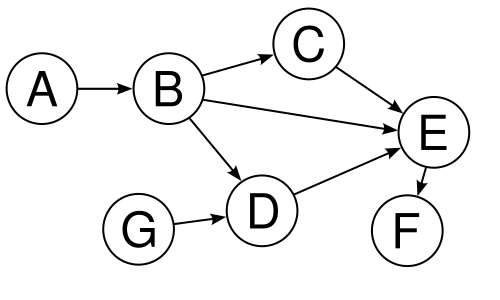
| DAG (Directed Acyclic Graph) | A structure that defines tasks and their dependencies. Each task can depend on others, but no circular dependencies are allowed. Airflow uses this as its core abstraction. |
| Task | A single unit of work in a pipeline. In Airflow, tasks are defined using Operators. In Prefect, tasks are Python functions decorated with @task. |
| Flow | Prefect's term for a complete pipeline, a Python function decorated with @flow that contains and coordinates tasks. |
| Operator | Airflow's pre-built task type. Python operators run arbitrary Python functions; Bash operators run shell commands; cloud operators interact with AWS, GCP, or Azure services. |
| XCom | Airflow's mechanism for passing small pieces of data between tasks. Short for cross-communication. Can be a source of confusion for new users. |
| Scheduler | The component that reads pipeline definitions and triggers runs at the appropriate times. Both Airflow and Prefect have schedulers. |
| Retry | Automatically re-executing a failed task after a delay. Both tools support configurable retry counts and delays. |
| Dynamic Tasks | Tasks whose number or configuration is determined at runtime based on data, rather than being fixed when the pipeline is written. Prefect handles this natively; Airflow requires workarounds. |
| Backfill | Running a pipeline for historical dates or data ranges that were missed. Airflow has strong built-in backfill support. |
How Workflow Orchestration Works
Think of an ML pipeline as a relay race. Each runner handles one leg of the race and passes the baton to the next. If a runner drops the baton, the race stops. Someone needs to notice, figure out what went wrong, and decide whether to restart from that position or go back to the start. Without orchestration, this is a human's job. With orchestration, the system handles it.
In concrete terms, here is how an orchestrated ML pipeline executes:
- The scheduler reads the pipeline definition. It checks whether all preconditions for a run are met: the scheduled time has arrived, or a trigger condition has been satisfied (such as a new file arriving in a storage bucket).
- Tasks are queued in dependency order. Tasks with no dependencies run first. Once they complete, the tasks that depend on them are queued. This continues until all tasks have run or one fails.
- Failed tasks are retried automatically. If a task fails due to a transient error, such as a network timeout or a momentarily unavailable service, the orchestrator waits a configured delay and tries again. After a defined number of retries, the task is marked as permanently failed and alerting is triggered.
- The run state is recorded. Every run, every task, every retry, and every output is logged. An engineer can open the UI days later and see exactly what happened, which tasks succeeded, which failed, what the error messages were, and how long each step took.
- Downstream tasks are skipped or handled gracefully. If a task fails permanently, the orchestrator can be configured to skip downstream tasks, mark the entire run as failed, or send an alert without stopping other independent tasks.
Apache Airflow: The Industry Standard
Apache Airflow was originally built at Airbnb in 2014 and is now maintained by the Apache Software Foundation. It has been adopted by thousands of companies and is the de facto standard for orchestrating data and ML pipelines in large enterprises.
Airflow defines pipelines as DAGs (Directed Acyclic Graphs) written in Python. Each DAG contains tasks, and tasks are linked by dependencies that determine execution order. The DAG structure is fixed at parse time, meaning it is evaluated before any data is known. This is one of Airflow's strengths and one of its most significant limitations.
Airflow's maturity shows in its ecosystem. It has native operators for AWS, GCP, Azure, Spark, dbt, Snowflake, and dozens of other tools. The community has been active for over a decade, which means most problems encountered in practice have documented solutions on Stack Overflow or in official documentation. This is not something to take lightly when debugging a production pipeline at two in the morning.
The cost of this maturity is operational complexity. Running Airflow in production requires a database (PostgreSQL or MySQL) to store run history, a scheduler process, a webserver process, and often a message broker (Redis or RabbitMQ) for distributing tasks to workers. This is significant infrastructure to provision, maintain, and monitor.
Airflow also has a meaningful learning curve. New concepts such as operators, hooks, XComs, connections, and providers take time to understand. Getting comfortable enough with Airflow to debug a non-obvious failure typically requires weeks of hands-on experience, not hours.
Prefect: Modern, Python-Native Orchestration
Prefect was built to address the pain points that Airflow users commonly encounter. Its core design principle is that workflows should feel like normal Python code. A data scientist who can write Python should be able to write Prefect flows without first learning a new conceptual framework.
In Prefect, you write regular Python functions and add decorators to turn them into orchestrated tasks and flows. The orchestration layer, including logging, retry support, state tracking, and dashboard visibility, activates automatically from the decorators. There is no need to learn about operators or hooks or understand how XComs work to pass data between tasks.
Prefect's most significant technical advantage over Airflow is dynamic task generation. Because Prefect flows are evaluated at runtime rather than at parse time, the number of tasks can be determined by actual data. If you need to process one task per file in a directory and the number of files changes every day, Prefect handles this naturally. In Airflow, achieving the same requires workarounds that add complexity to the pipeline code.
Prefect also has a notably better failure recovery story. It supports resuming a flow from the point of failure rather than restarting the entire run. For long ML pipelines where data ingestion takes an hour but training is what failed, this is a meaningful practical difference.
The trade-off is ecosystem breadth. Airflow's library of pre-built operators covers many more integrations. In Prefect, you often write integration code yourself. For teams that primarily use standard Python libraries and popular cloud services, this is rarely a problem. For teams with unusual integrations or legacy systems, it may matter.
Practical Example
Suppose a team runs a daily pipeline that fetches sales data from a database, computes features, retrains a demand forecasting model, evaluates the new model against the previous week's model, and deploys it if it improved.
In Airflow, the team defines a DAG with five tasks linked in sequence. The pipeline runs on a cron schedule at two in the morning. If the database fetch fails due to a connection timeout, Airflow retries the task three times with exponential backoff. If all retries fail, it marks the task as failed, alerts the on-call engineer via Slack, and stops the run. The engineer opens the Airflow web UI, reads the task logs, fixes the connection issue, and triggers a manual backfill for the missed date.
In Prefect, the team writes the same pipeline as a Python flow function containing five task calls. If a new data source requires processing a variable number of regional datasets each day (some days three regions, some days seven), Prefect handles this with a simple loop inside the flow function. Airflow would require a dynamic DAG generation pattern that is significantly more complex to write and maintain.
Both pipelines solve the same problem. The Airflow version benefits from more pre-built connector code. The Prefect version is easier for a Python developer to write and modify quickly.
Advantages
Advantages of Airflow:
- Battle-tested reliability. Airflow has been running in production at scale for over a decade. Its failure modes are well understood and its behavior under load is predictable.
- Deep integration ecosystem. Native operators for nearly every data tool, cloud service, and database that an enterprise team might use, often with no custom code required.
- Strong scheduling primitives. Cron-style schedules, time-based triggers, data-aware scheduling (trigger when a file arrives), and backfill support are mature and well-tested.
- Large community. Years of tutorials, Stack Overflow answers, and third-party plugins mean most problems have documented solutions.
Advantages of Prefect:
- Natural Python experience. No new conceptual framework required. Data scientists and ML engineers can be productive quickly.
- Dynamic task generation. Tasks can be created at runtime based on actual data, without workarounds or complex patterns.
- Superior failure recovery. Flows can resume from the point of failure rather than restarting from the beginning, which saves significant time for long pipelines.
- Lower infrastructure burden. Prefect requires much less infrastructure to get started than Airflow. A local development setup is trivial, and Prefect Cloud handles production monitoring without requiring a self-hosted stack.
Limitations and Trade-offs
- Airflow's static DAG structure makes dynamic pipelines awkward. Generating tasks based on runtime data requires patterns that fight against the framework's design.
- Airflow's infrastructure requirements are substantial. A production Airflow installation requires ongoing operational maintenance that small teams may not have capacity for.
- Airflow's learning curve is steep. Understanding operators, hooks, XComs, connections, and providers takes weeks of practice before a new user is fully productive.
- Prefect's ecosystem is smaller. Fewer pre-built integrations means more custom code for teams with diverse tooling. This gap has been closing but has not disappeared.
- Prefect has less organizational adoption. Many enterprises have standardized on Airflow. Introducing Prefect requires justification and change management even when it is the better technical fit.
- Both tools require pipeline code maintenance. Workflow definitions are code, and like all code they accumulate technical debt, require updates as dependencies change, and can break in subtle ways after upgrades.
Common Mistakes
- Choosing Airflow because it is the default without evaluating the team's actual needs. Airflow is a good choice in many contexts, but its complexity is real. Teams that do not need enterprise integrations and have no existing Airflow investment often find Prefect faster to adopt and easier to maintain.
- Designing monolithic tasks that do too much. A single task that fetches data, cleans it, trains the model, evaluates it, and deploys it cannot be retried at the step level. Tasks should be granular enough that a failure can be retried without repeating expensive work.
- Not testing pipelines in a staging environment. Running a production pipeline for the first time on real data is how subtle dependency and ordering bugs get discovered expensively. Always test against representative data in a non-production environment first.
- Ignoring pipeline performance monitoring. Task completion is not the same as pipeline health. A model evaluation task that completes but reports accuracy below the baseline is a silent failure if nobody is checking the output values.
- Not version-controlling pipeline definitions. Editing DAG or flow files directly in production without code review or version history is how working pipelines get accidentally broken with no way to see what changed.
Best Practices
- Design modular pipelines with granular tasks. Separate data ingestion, validation, preprocessing, training, evaluation, and deployment as distinct tasks. This enables targeted retries, independent testing, and clearer debugging.
- Monitor pipeline outputs, not just task completion. A task that runs and produces a degraded model is worse than a task that fails loudly. Check the values coming out of each step, not just whether the step ran without error.
- Version-control all pipeline definitions. Treat DAG and flow code with the same rigor as application code. Require code reviews for pipeline changes and maintain a full commit history.
- Define retry logic before you need it. Every external call in an ML pipeline, to a database, an API, a storage service, can fail transiently. Configure sensible retry counts and delays from the start rather than adding them reactively after the first production failure.
- Build a staging pipeline that mirrors production. Run the full pipeline against a sample of real data in a staging environment regularly. This catches integration and data issues before they affect production runs.
- Instrument pipelines with explicit output logging. Log model accuracy, data row counts, processing times, and other meaningful metrics at each task boundary. This data is invaluable for diagnosing slow regressions that do not cause task failures.
Comparison Table
| Feature | Apache Airflow | Prefect |
|---|---|---|
| Workflow definition | Static DAGs defined at parse time in Python | Dynamic flows evaluated at runtime in Python |
| Learning curve | Steep. Requires learning operators, hooks, XComs, connections | Gentle. Standard Python functions with decorators |
| Dynamic task generation | Possible but requires workarounds and complex patterns | Native and straightforward |
| Failure recovery | Restart from a specific task, but typically reruns from beginning of failed DAG run | Resume from point of failure within a flow |
| Infrastructure required | Database, scheduler, webserver, optional message broker | Minimal. Lightweight local server or Prefect Cloud |
| Integration ecosystem | Very extensive. Decades of operators and providers | Growing. Good coverage of common tools |
| Scheduling | Very powerful. Cron, time-based, data-aware triggers, backfill | Cron-based. Sufficient for most ML use cases |
| Monitoring UI | Built-in web UI with DAG graph, task logs, and run history | Prefect Cloud UI or self-hosted server |
| Community and adoption | Very large. Industry standard in enterprises | Smaller but active and growing |
| Best fit | Large organizations with existing infrastructure and stable, integration-heavy pipelines | ML teams wanting fast iteration, dynamic pipelines, and a Python-first experience |
FAQ
Can Airflow and Prefect be used together in the same organization?
Yes, and this is a common pattern in practice. Many organizations use Airflow for established data engineering pipelines with complex integration requirements, and Prefect for newer ML workflows where dynamic task generation and fast iteration matter. The two tools can coexist without conflict, triggering each other through API calls if needed.
Is Prefect suitable for enterprise use, or is it just for smaller teams?
Prefect is used in production by large organizations. Prefect Cloud provides enterprise features including role-based access control, SSO, audit logs, and dedicated infrastructure. The limitation is not scale but ecosystem maturity. If your pipelines depend heavily on pre-built operators for enterprise systems, Airflow's connector library is broader. If your pipelines are primarily Python-based, Prefect scales well.
How long does it take to get productive with each tool?
A Python developer with no prior experience can typically write and run a basic Prefect flow within a day or two. Getting productive with Airflow takes longer, typically one to three weeks, because of the additional concepts required: operators, hooks, XComs, connections, and providers. Both tools require more time to master for production use, including understanding performance tuning, monitoring, and failure recovery at scale.
What should I do if my team is already using Airflow but it feels painful?
First diagnose the source of pain. If it is operational complexity, consider managed Airflow services like Google Cloud Composer or Amazon MWAA, which handle infrastructure management. If it is the programming model, specifically the difficulty of dynamic tasks and verbose boilerplate, Prefect may genuinely be a better fit for your use cases. Migrating an established Airflow installation has real costs, so only pursue it if the pain is significant and persistent.
References
- Apache Airflow Documentation
- Prefect Documentation
- Casado, M., & Bornstein, M. (2020). The New Business of AI (and How It's Different from Traditional Software). Andreessen Horowitz.
- MLOps Community. Pipeline Orchestration.
- Sculley, D., et al. (2015). Hidden Technical Debt in Machine Learning Systems. NeurIPS 2015.
Key Takeaways
- Workflow orchestration solves one of the most common ML production problems: pipelines that run unreliably, fail silently, and are difficult to debug. Every serious ML team needs some form of it.
- Airflow is the mature, enterprise-grade choice with the deepest integration ecosystem. It is the right pick when your organization already runs it, your pipelines are stable and integration-heavy, and you have infrastructure support.
- Prefect is the modern Python-native choice that excels at dynamic task generation and provides a significantly lower barrier to entry. It is the right pick for ML teams who want to move fast and value developer experience.
- The most important comparison point is not feature lists but how each tool behaves when a pipeline fails. Prefect's resume-from-failure capability and clearer error messages often matter more in practice than Airflow's broader operator library.
- Both tools improve with modular pipeline design. Granular tasks enable targeted retries, independent testing, and clearer debugging regardless of which orchestrator you use.
- Many organizations end up using both. There is no rule that says you must choose one for everything.